Pool gallon calculator: how much water your pool holds
The short answer. To find how many gallons your pool holds, multiply length times width times average depth to get cubic feet, and every cubic foot holds 7.48 US gallons. For a round pool, multiply the diameter by itself, then by average depth, then by 5.87. An oval uses that same 5.87.
Those two figures are not rules of thumb: a US gallon is 231 cubic inches and a cubic foot is 1,728, which divides to 7.4805, and the circle figure is that number multiplied by pi over four.
What this page will not do is hand you a single multiplier for a kidney or freeform pool, because no such number exists for an arbitrary shape. For those you get a bracket, and the reasoning for it.
The calculator
Enter feet, using decimals for inches: six inches is 0.5, and three inches is 0.25. If your pool is a constant depth, put the same figure in both depth boxes.
Gallons for common pool sizes
These are the calculator's own figures for sizes people search for most, rounded the same way. Each depth is the depth of the water, not the height of the wall. An above-ground pool is never filled to the top of its wall, so measure from the water surface to the floor and read the column closest to that figure.
| Round pool | 3.5 ft of water | 4 ft of water |
|---|---|---|
| 12 ft round | 2,950 gallons | 3,400 gallons |
| 15 ft round | 4,650 gallons | 5,300 gallons |
| 18 ft round | 6,700 gallons | 7,600 gallons |
| 21 ft round | 9,100 gallons | 10,400 gallons |
| 24 ft round | 11,800 gallons | 13,500 gallons |
| 27 ft round | 15,000 gallons | 17,100 gallons |
| 30 ft round | 18,500 gallons | 21,200 gallons |
A rectangular inground pool usually slopes, so the columns below are average depth. Work that out as described in the section on depth further down before you read across.
| Rectangle | 4.5 ft avg. depth | 5.5 ft avg. depth |
|---|---|---|
| 12 × 24 ft | 9,700 gallons | 11,800 gallons |
| 15 × 30 ft | 15,100 gallons | 18,500 gallons |
| 16 × 32 ft | 17,200 gallons | 21,100 gallons |
| 18 × 36 ft | 21,800 gallons | 26,700 gallons |
| 20 × 40 ft | 26,900 gallons | 32,900 gallons |
The arithmetic, if you would rather do it yourself
Where 7.48 comes from
A US gallon is defined as 231 cubic inches. A cubic foot is twelve inches cubed, which is 1,728 cubic inches. Divide 1,728 by 231 and the answer is 7.4805, so a cubic foot of water is a little under seven and a half gallons. That is the whole of it. Nothing on this page is a figure someone published that everyone else copied.
Round and oval pools share a multiplier
A circle of diameter d has an area of pi times d squared over four, which is 0.7854 times the square that would enclose it. Multiply 7.4805 by 0.7854 and you get 5.875, so a round pool is diameter times diameter times average depth times 5.87.
An oval is an ellipse, and an ellipse of length L and width W has an area of pi over four times L times W, the same 0.7854 fraction of its bounding rectangle. That is why the oval multiplier and the round multiplier are the same number, which surprises people often enough to be worth stating.
| Shape | Gallons | Where the multiplier comes from |
|---|---|---|
| Rectangular | L × W × avg depth × 7.48 | 1,728 ÷ 231, the cubic inches in a foot over the cubic inches in a gallon |
| Round | d × d × avg depth × 5.87 | 7.4805 × (pi ÷ 4), because a circle fills 78.54% of its bounding square |
| Oval | L × W × avg depth × 5.87 | Identical to the circle: an ellipse fills the same 78.54% of its bounding rectangle |
| Kidney or freeform | No single multiplier | The factor is your pool's area over its bounding rectangle, which is different for every freeform pool |
Freeform pools have no honest multiplier
Most calculators give kidney and freeform pools a number anyway, and the figures in circulation disagree with each other, which is the tell.
The multiplier for a curved pool is nothing more than the ratio of its surface area to the rectangle that would enclose it, and that ratio depends entirely on how the shape was drawn.
A pool that is nearly rectangular with rounded corners sits close to 7.48. A pool with deep waists and long curves sits closer to the ellipse figure of 5.87. Publishing one number for both would be inventing a fact about your garden.
So take the bracket. Work it out as an ellipse for the bottom of the range and as a full rectangle for the top, and treat your real volume as sitting between them. If that spread is too wide for what you are doing, the fix is not a better multiplier, it is better measurement: divide the pool into rectangles and circles you can measure individually and add the results.
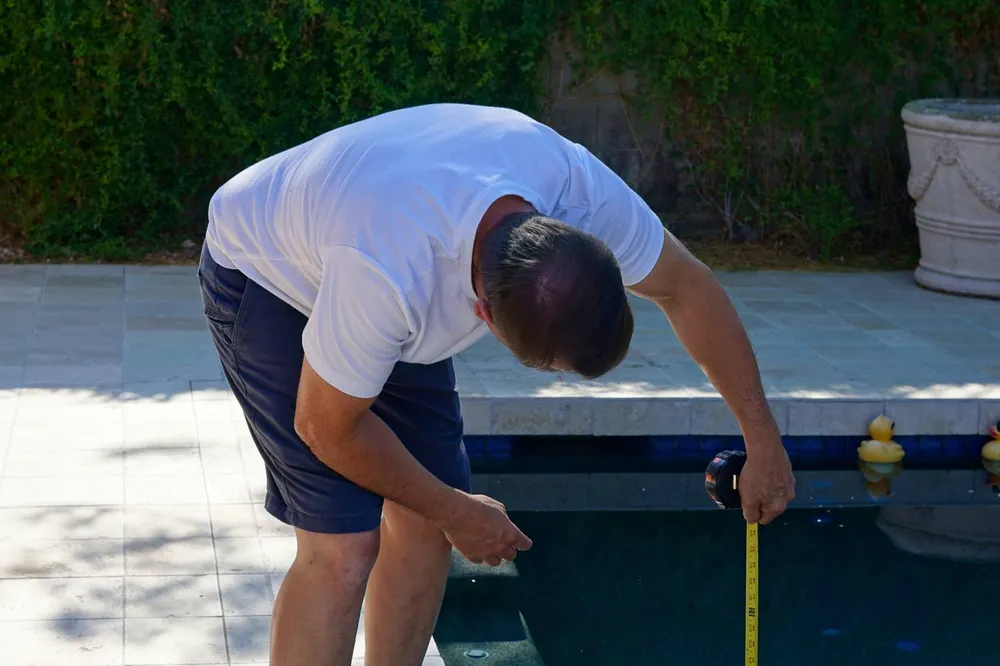
Average depth is where most estimates go wrong
Volume errors usually come from depth rather than from length or width, because length and width get measured and depth gets assumed. If the floor slopes evenly from end to end, average depth is the shallow depth plus the deep depth divided by two, and that is genuinely accurate.
Most inground pools are not built that way. They have a flat shallow section, then a slope, then a smaller flat deep section, and the shallow part is usually the longest of the three.
Averaging only the two end depths then overstates your volume, because it treats the pool as though the slope ran the whole length. Measure how long each of the three sections is, and weight the depths by those lengths instead.
What the number is for, and what it is not for
Volume is the number chemistry runs on. Every dose on every bottle is expressed per gallon, so a volume that is ten percent out becomes a ten percent error in every chemical you add for as long as you own the pool.
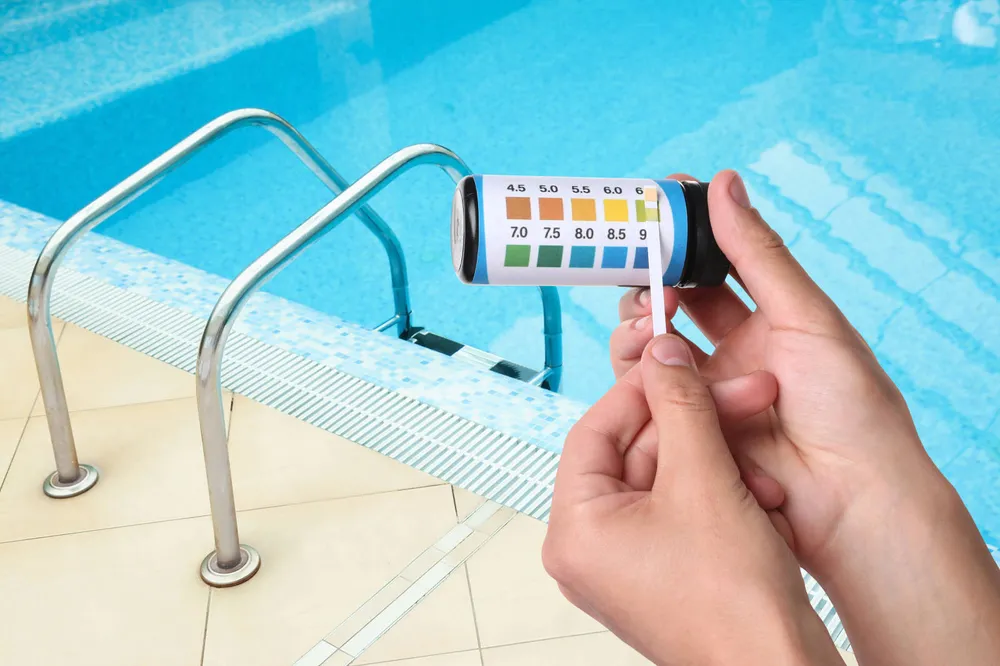
It is also what a yearly running cost is built from, which our page on what a pool costs to run works through with each figure attributed and dated.
It is not the number for choosing a machine, and this trips people up. Makers size cleaners against the pool itself rather than against its volume, and they do not even agree on which measure: Maytronics rates the Nautilus CC Plus by length, at up to 40 feet, while Beatbot rates the AquaSense 2 Pro by surface area, at up to 3,875 square feet. Neither of them asks for gallons.
A large shallow pool and a small deep one can hold the same water and need completely different cleaners. If that is the decision in front of you, the main comparison is the page you want, and the inground guide covers sizing to length properly.
Frequently asked questions
How many gallons is my pool?
Multiply length by width by average depth to get cubic feet, then multiply by 7.48 to get US gallons, because one cubic foot holds 7.48 gallons. For a round pool multiply diameter by itself, then by average depth, then by 5.87. An oval uses the same 5.87 figure as a circle, because an ellipse and a circle share the same area formula.
Where does the 7.48 come from?
It is arithmetic rather than a rule of thumb. A US gallon is defined as 231 cubic inches, and a cubic foot is 12 by 12 by 12, which is 1,728 cubic inches. Divide 1,728 by 231 and you get 7.4805, so every cubic foot of your pool holds a little under seven and a half gallons.
What multiplier should I use for a kidney or freeform pool?
None, and any calculator that gives you one is guessing about your pool. The multiplier is really the ratio between your pool's surface area and the rectangle that would enclose it, and that ratio is different for every freeform shape.
Work out the bracket instead: treat the pool as an ellipse for the low estimate and as a full rectangle for the high one. Your real volume sits between them, and if you need better than that, split the pool into rectangles and circles you can measure and add them up.
How do I find average depth if my pool has a deep end?
If the floor slopes evenly from one end to the other, average depth is simply the shallow depth plus the deep depth divided by two.
If your pool has a flat shallow section, then a slope, then a flat deep section, that simple average is wrong and usually too high, because the shallow section is normally the longest part. Measure the length of each of the three sections and weight the depths by those lengths.
Do I need the volume to choose a robotic cleaner?
No, and this is worth separating clearly. Manufacturers size robotic cleaners against the pool itself rather than against its volume, though they do not agree on which measure: Maytronics rates the Nautilus CC Plus by length, at up to 40 feet, while Beatbot rates the AquaSense 2 Pro by surface area, at up to 3,875 square feet. Neither uses gallons.
Volume is what chemistry runs on: every dose on every bottle is per gallon, so an error in your volume becomes the same error in every chemical you add for as long as you own the pool.
This page sells nothing
There is no affiliate link on this page and there will not be one. A calculator is only worth linking to if it is not a sales funnel, and we would rather be the page other people cite than the page that converted one more reader. How the rest of the site is funded is here.